
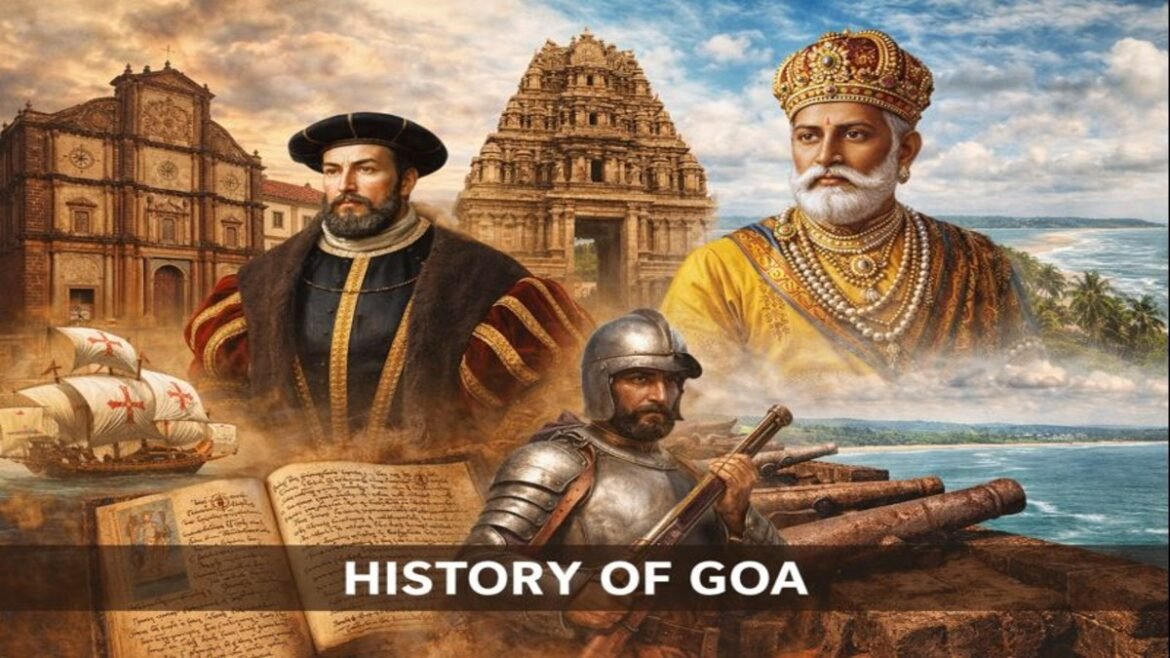
Introduction to Goa’s Historical Significance
History of Goa. Goa may be India’s smallest state, but when it comes to history, it packs a punch far bigger than its size. Sitting pretty along the western coast of India, Goa has been a melting pot of cultures, empires, religions, and traditions for thousands of years. Its story feels less like a straight road and more like a winding river sometimes calm, sometimes turbulent, but always fascinating.
Why Goa’s History Is Unique in India
What makes History of Goa stand out is its long period of European rule. While most of India experienced British dominance, Goa remained under Portuguese control for over 450 years. This gave birth to a rare Indo-European culture that you simply won’t find anywhere else in the country.
Geography and Its Role in Shaping Goa
Goa’s natural harbors, rivers like the Mandovi and Zuari, and access to the Arabian Sea made it a prime target for traders and conquerors alike. Geography didn’t just shape Goa’s economy—it shaped its destiny.
Prehistoric and Ancient History of Goa
Early Human Settlements
History of Goa dates back to prehistoric times. Stone tools discovered along riverbanks suggest that early humans lived here long before recorded history began.
Archaeological Evidence and Findings
Rock engravings, megalithic structures, and burial sites tell us that Goa was home to organized communities with their own rituals and lifestyles.
Goa in Ancient Indian Texts
Ancient Sanskrit texts refer to History of Goa as Gomantak, a land said to be reclaimed from the sea by the sage Parashurama. Myth or not, it shows how deeply Goa was woven into early Indian imagination.
Goa Under Mauryan and Satavahana Rule
Political Influence of Early Indian Empires
By the 3rd century BCE, Goa came under the Mauryan Empire, followed by the Satavahanas. These rulers introduced structured administration and boosted trade.
Trade and Cultural Exchange
Roman coins found in Goa hint at international trade links. Spices, pearls, and textiles flowed out, while ideas and cultures flowed in.
Goa During the Kadamba Dynasty
Rise of the Kadambas
The Kadamba dynasty marked Goa’s first major local rule around the 10th century. They made Goa an important political and cultural center.
Administration and Culture
Efficient governance, land grants, and temple patronage defined this era. Sanskrit and Kannada flourished as administrative languages.
Architectural and Religious Developments
Many early temples and inscriptions from this period show a deep-rooted Hindu cultural identity.
Influence of the Chalukyas and Rashtrakutas
Military and Political Control
History of Goa later fell under the Chalukyas and Rashtrakutas, powerful Deccan dynasties that fought fiercely for control of western India.
Impact on Local Society
These rulers strengthened fortifications and encouraged art and literature, adding new layers to Goa’s evolving identity.
Goa Under the Vijayanagara Empire
Economic Growth and Trade
Under the Vijayanagara Empire, Goa became a thriving trade hub. Horses imported from Arabia were especially valuable to South Indian armies.
Hindu Culture and Temple Building
This period saw a revival of Hindu traditions and temple construction, many of which still influence Goan culture today.
Bahmani Sultanate and Adil Shahi Rule
Islamic Influence in Goa
The Bahmani Sultanate and later the Adil Shahis of Bijapur introduced Islamic governance and culture to Goa.
Architecture and Governance
Mosques, forts, and new administrative systems emerged, blending Persian styles with local craftsmanship.
Arrival of the Portuguese (1510)
Vasco da Gama and the Sea Route to India
Vasco da Gama’s voyage opened the door for European powers to reach India by sea, changing global trade forever.
Afonso de Albuquerque’s Conquest of Goa
In 1510, Afonso de Albuquerque captured Goa, marking the beginning of Portuguese rule that would last more than four centuries.
Conclusion
The history of Goa is like a richly layered cake—each era adding its own flavor. From ancient settlements and mighty Indian empires to centuries of Portuguese rule and finally integration into modern India, Goa’s past is as vibrant as its present. Understanding its history helps us appreciate why Goa feels so different, so alive, and so unforgettable.
FAQs: History of Goa
1. Who ruled Goa before the Portuguese?
Goa was ruled by several dynasties, including the Mauryas, Satavahanas, Kadambas, Vijayanagara Empire, and the Adil Shahis.
2. Why is Goa called the “Rome of the East”?
Because of its many grand churches and its importance as a center of Christianity during Portuguese rule.
3. When did Goa become part of India?
Goa was liberated from Portuguese rule and became part of India in 1961.
4. How long did the Portuguese rule Goa?
The Portuguese ruled Goa for about 451 years, from 1510 to 1961.
5. When did Goa become a full-fledged state?
Goa became India’s 25th state on May 30, 1987.