Introduction to Science
What is Science. Have you ever wondered why the sky is blue, how plants grow, or what makes your phone work? All these questions fall under one powerful concept science. At its core, science is the way humans try to understand the world around them. It’s not just something you study in school; it’s a method of thinking, exploring, and discovering.
Think of science as a toolkit. Instead of giving you answers directly, it teaches you how to find them. It encourages curiosity and helps you ask better questions. From the smallest atoms to the vast universe, science helps explain everything step by step.
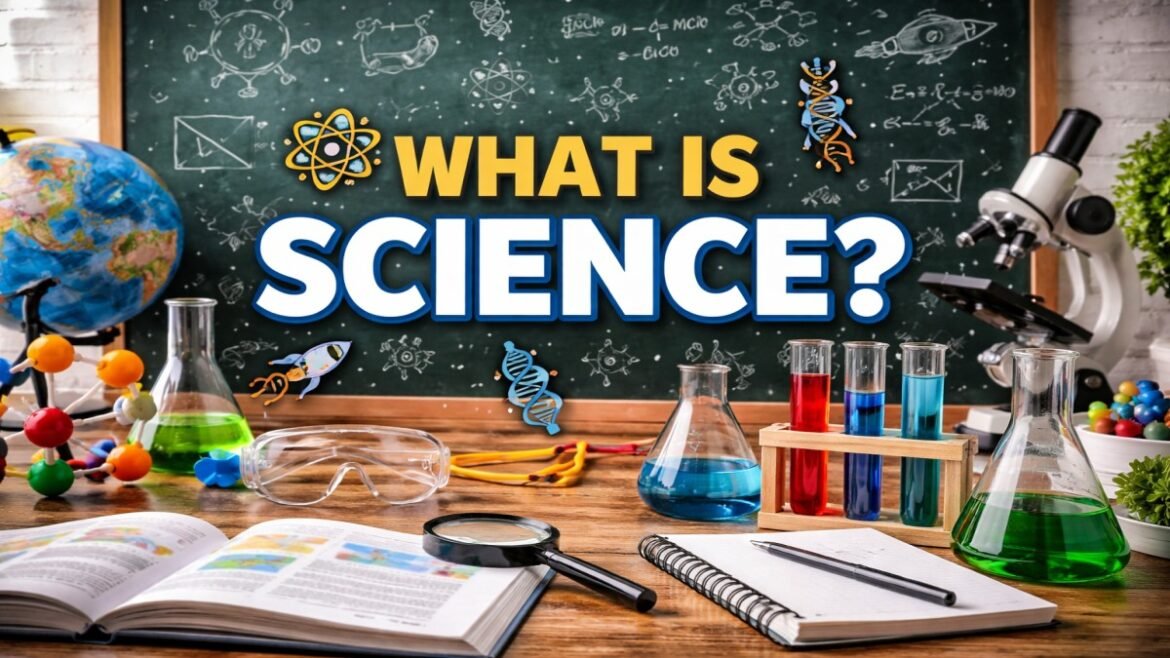
What is Science?
Science is a systematic way of learning about the natural world through observation, experimentation, and reasoning. In simple terms, it is the process of asking questions and finding answers using evidence.
Unlike guesses or opinions, science relies on facts. Scientists observe things carefully, conduct experiments, and test their ideas repeatedly to make sure they are correct. This process makes science reliable and trustworthy.
For example, if you want to know why ice melts, science doesn’t just say “because it does.” Instead, it explains how temperature affects molecules and changes solid ice into liquid water.
Branches of What is Science
Science is a vast field, and it is divided into different branches to make it easier to study.
1. Physical Science
Physical science focuses on non-living things. It includes subjects like physics and chemistry. Physics explains how forces and energy work, while chemistry studies substances and how they react.
2. Life Science
Life science is all about living organisms. It includes biology, which studies plants, animals, and humans. It helps us understand how life functions and evolves.
3. Earth and Space Science
This branch explores the Earth, weather, oceans, and the universe. It includes geology, astronomy, and meteorology. It helps us understand natural events like earthquakes and climate change.
Importance of Science in Daily Life
Science is not just limited to laboratories—it is part of our everyday lives. From the moment you wake up, you use science in different ways.
When you turn on a light, use a smartphone, or cook food, science is involved. It helps improve our quality of life by making tasks easier and faster. Medical advancements, for example, have helped cure diseases and increase life expectancy.
Science also helps us make informed decisions. Whether it’s choosing healthy food or understanding environmental issues, science provides the knowledge we need.
Scientific Method Explained
One of the most important aspects of science is the scientific method. This is the process scientists use to investigate questions.
Here’s how it works:
- Ask a question – What do you want to know?
- Make a hypothesis – What do you think will happen?
- Conduct an experiment – Test your idea.
- Analyze results – What did you find?
- Draw conclusions – Was your hypothesis correct?
This method ensures that conclusions are based on evidence, not guesses.
Science vs. Technology
People often confuse science with technology, but they are different.
| Science | Technology |
|---|---|
| Studies natural laws | Applies scientific knowledge |
| Focuses on understanding | Focuses on creating tools |
| Example: Gravity | Example: Airplane |
Science discovers, while technology uses those discoveries to solve problems.
Why Science is Important for the Future
Science plays a crucial role in shaping the future. It helps us solve global challenges like climate change, energy shortages, and health issues.
New scientific discoveries lead to innovation and progress. For example, renewable energy sources like solar and wind power are helping reduce pollution. Similarly, advancements in medicine are improving healthcare worldwide.
Science also inspires creativity and critical thinking. It encourages people to question, explore, and innovate, which are essential skills in today’s world.
Conclusion
Science is more than just a subject—it’s a way of understanding life and the universe. It helps us explore the unknown, solve problems, and improve our lives. From simple daily activities to complex discoveries, science plays a role in everything.
By learning science, you’re not just gaining knowledge—you’re developing the ability to think, question, and discover. And that’s what makes science truly powerful.
FAQs
1. What is science in simple words?
Science is the study of the natural world through observation and experiments.
2. Why is science important?
It helps us understand how things work and improves our quality of life.
3. What are the main branches of science?
Physical science, life science, and Earth & space science.
4. What is the scientific method?
It is a step-by-step process used to investigate questions and find answers.
5. Is science used in daily life?
Yes, science is involved in everyday activities like cooking, using electricity, and healthcare.