
Introduction
Have you ever looked at a world map and noticed a line labeled the Tropic of Cancer? It might seem like just another imaginary line, but in reality, it plays a crucial role in how our planet works. From influencing climate patterns to marking the northernmost point where the sun shines directly overhead, the Tropic of Cancer is far more important than most people realize.
Let’s break it down in simple terms so you can fully understand what it is, where it lies, and why it matters.
What Is the Tropic of Cancer?
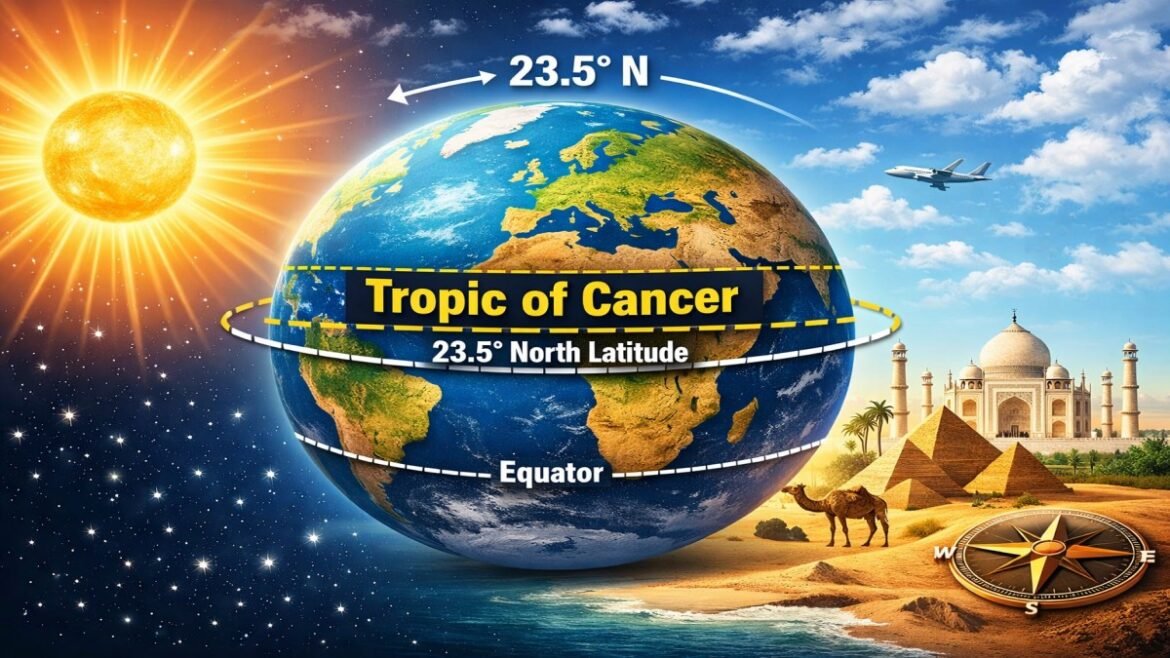
The Tropic of Cancer is an imaginary line of latitude located at approximately 23.5 degrees north of the Equator. It marks the northern boundary of the tropics, the region where the sun can appear directly overhead at noon.
This phenomenon occurs during the June Solstice, usually around June 21 each year. On this day, the sun is directly above the Tropic of Cancer, making it the longest day of the year in the Northern Hemisphere.
Think of it like a spotlight moving across the Earth. At one point in the year, that spotlight shines directly over this line—making it a key reference point in geography and astronomy.
Why Is It Called the Tropic of Cancer?
The name “Cancer” comes from the zodiac constellation Cancer the Crab. Thousands of years ago, when ancient astronomers named this line, the sun appeared in the Cancer constellation during the June Solstice.
Although due to Earth’s gradual axial shift (called precession), the sun is no longer in that exact constellation during the solstice, the name has remained unchanged.
Countries Through the Tropic of Cancer
The Tropic of Cancer passes through several countries across different continents. This includes parts of North America, Africa, and Asia.
Here are some of the major countries it crosses:
- Mexico
- Egypt
- Saudi Arabia
- India
- China
- Bangladesh
In India, for example, it divides the country into tropical and subtropical regions, influencing agriculture, climate, and biodiversity.
Importance of the Tropic of Cancer
You might be wondering—why does this line even matter? The answer lies in how it affects life on Earth.
1. Climate Zones
The Tropic of Cancer helps define the tropical zone, which lies between it and the Tropic of Capricorn. This region receives more direct sunlight compared to other parts of the Earth, leading to warmer temperatures.
2. Seasonal Changes
It plays a key role in understanding seasons. When the sun is overhead at this latitude, the Northern Hemisphere experiences summer, while the Southern Hemisphere experiences winter.
3. Agriculture and Ecosystems
Regions near the Tropic of Cancer often have unique ecosystems and farming patterns. Crops like rice, sugarcane, and tropical fruits thrive in these areas due to the warm climate.
4. Navigation and Mapping
Historically, this line helped sailors and explorers navigate the globe. Even today, it is used as a reference point in geography and mapping.
Difference Between Tropic of Cancer and Tropic of Capricorn
Many people confuse the Tropic of Cancer with the Tropic of Capricorn. While both are important, they are located in different hemispheres.
| Feature | Tropic of Cancer | Tropic of Capricorn |
|---|---|---|
| Latitude | 23.5° North | 23.5° South |
| Hemisphere | Northern | Southern |
| Sun overhead | June Solstice | December Solstice |
| Climate | Tropical (North) | Tropical (South) |
Both lines mark the boundaries of the tropical zone, but they function in opposite hemispheres.
Interesting Facts About the Tropic of Cancer
- The position of the Tropic of Cancer is not fixed—it shifts slightly over time due to changes in Earth’s tilt.
- It passes through deserts, forests, and even mountains, showing its wide geographical reach.
- In some countries, monuments are built to mark this line, attracting tourists.
- It plays a role in determining daylight hours and temperature variations.
Conclusion
The Tropic of Cancer is much more than just a line on a map—it’s a key element in understanding how our planet functions. From influencing seasons and climate to shaping ecosystems and agriculture, its impact is everywhere. Once you understand its role, you begin to see the Earth not just as a place, but as a dynamic system where even imaginary lines have real-world significance.
FAQs
1. What is the Tropic of Cancer in simple terms?
It is an imaginary line at 23.5° north of the Equator where the sun is directly overhead during the June Solstice.
2. Why is the Tropic of Cancer important?
It helps define climate zones, seasons, and the tropical region of the Earth.
3. Which country is closest to the Tropic of Cancer?
Many countries lie on it, including India, Mexico, and Egypt.
4. Does the Tropic of Cancer move?
Yes, it shifts slightly over time due to changes in Earth’s tilt.
5. What happens when the sun is over the Tropic of Cancer?
The Northern Hemisphere experiences the longest day of the year.