
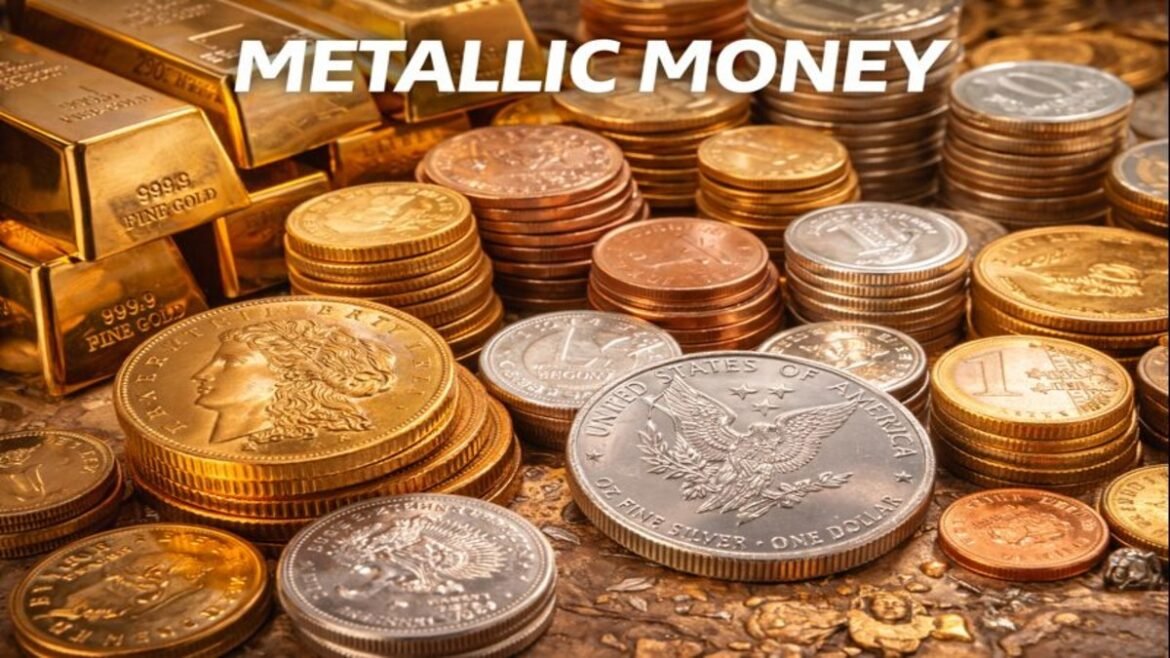
Introduction to Metallic Money
Money hasn’t always been paper notes or digital numbers on a screen. Long before wallets and mobile apps, people trusted something solid, shiny, and heavy metallic money. It jingled in pockets, passed from hand to hand, and carried real value you could actually feel.
Even today, metallic money continues to play a quiet but important role in global economies. Let’s take a deep, easy-to-understand journey into what metallic money is, where it came from, and why it still matters.
What Is Metallic Money?
Simple Definition
Metallic money refers to money made from metals such as gold, silver, copper, or alloys, usually in the form of coins. Its value traditionally comes from the metal itself, not just government backing.
In simple terms, it’s money that has intrinsic value.
Key Characteristics
- Made from precious or semi-precious metals
- Durable and long-lasting
- Has intrinsic and face value
- Portable and divisible
History of Metallic Money
Early Use of Metal as Money
Before coins, people used barter systems. But barter was messy and inconvenient. Metals solved that problem. Ancient societies discovered that metals were:
- Rare
- Durable
- Easy to shape
This made them perfect for trade.
Gold and Silver Standards
Gold and silver became the backbone of early economies. Civilizations like the Lydians, Romans, Greeks, and Chinese minted standardized coins to simplify trade.
Evolution Across Civilizations
From Roman denarii to Islamic dinars and medieval European coins, metallic money shaped trade routes, empires, and economic systems across centuries.
Types of Metallic Money
Gold Coins
Gold coins were often used for large transactions and wealth storage. They symbolized power and stability.
Silver Coins
Silver coins were more common for daily trade due to their lower value compared to gold.
Copper and Bronze Coins
Used for small transactions, these metals made money accessible to common people.
Alloy-Based Coins
Modern coins often use alloys (metal mixtures) for durability and cost efficiency.
How Metallic Money Is Made
Mining and Refining
The process starts deep underground. Metals are mined, purified, and refined to achieve the required purity.
Coin Minting Process
- Metal sheets are prepared
- Blanks are cut
- Designs are stamped
- Coins are polished and inspected
Functions of Metallic Money
Medium of Exchange
It allows goods and services to be exchanged easily.
Store of Value
Unlike perishable goods, metal retains value over time.
Unit of Account
Prices can be measured and compared using metallic money.
Advantages of Metallic Money
- Intrinsic value
- Highly durable
- Resistant to inflation (especially gold)
- Universally accepted historically
- Cannot be easily counterfeited
Disadvantages of Metallic Money
- Heavy and inconvenient
- Limited supply
- Expensive to store and transport
- Not suitable for large-scale modern economies
Metallic Money vs Paper Money
| Feature | Metallic Money | Paper Money |
|---|---|---|
| Value | Intrinsic | Representative |
| Durability | Very high | Moderate |
| Portability | Low | High |
| Inflation Risk | Low | High |
Metallic Money vs Digital Currency
Digital currencies are fast and convenient, but metallic money offers tangible security. One exists in code; the other exists in your hand.
Role of Metallic Money in Modern Economies
Although no longer the primary currency, metallic money is still used as:
- Coins for daily transactions
- Reserve assets (gold)
- Investment tools
Collectible and Investment Value
Numismatic Coins
Rare coins valued for history and design.
Bullion Coins
Purchased for metal value, often used as inflation hedges.
Why Metallic Money Still Matters Today
In uncertain economic times, people often turn back to metals. Gold especially is seen as a safe haven during inflation and financial crises.
Future of Metallic Money
While digital systems dominate, metallic money will likely remain:
- A backup store of value
- A collector’s treasure
- A symbol of economic stability
Common Myths About Metallic Money
- ❌ “Metallic money is outdated”
- ❌ “Coins have no real value”
- ❌ “Gold is useless in modern times”
All false. Metallic money still holds cultural, economic, and financial importance.
Conclusion
Metallic money is more than old coins and shiny metals. It represents trust, value, and stability across human history. While the world races toward digital payments, metallic money quietly holds its ground as a timeless symbol of wealth and security.
FAQs About Metallic Money
1. What is metallic money in simple words?
Metallic money is money made from metals like gold, silver, or copper.
2. Is metallic money still used today?
Yes, mainly as coins and investment assets.
3. Why was metallic money replaced by paper money?
Paper money is lighter, easier to transport, and supports large economies.
4. Is gold considered metallic money?
Yes, gold is the most famous form of metallic money.
5. Does metallic money have intrinsic value?
Yes, its value comes from the metal itself.