What Is a UAV Drone?
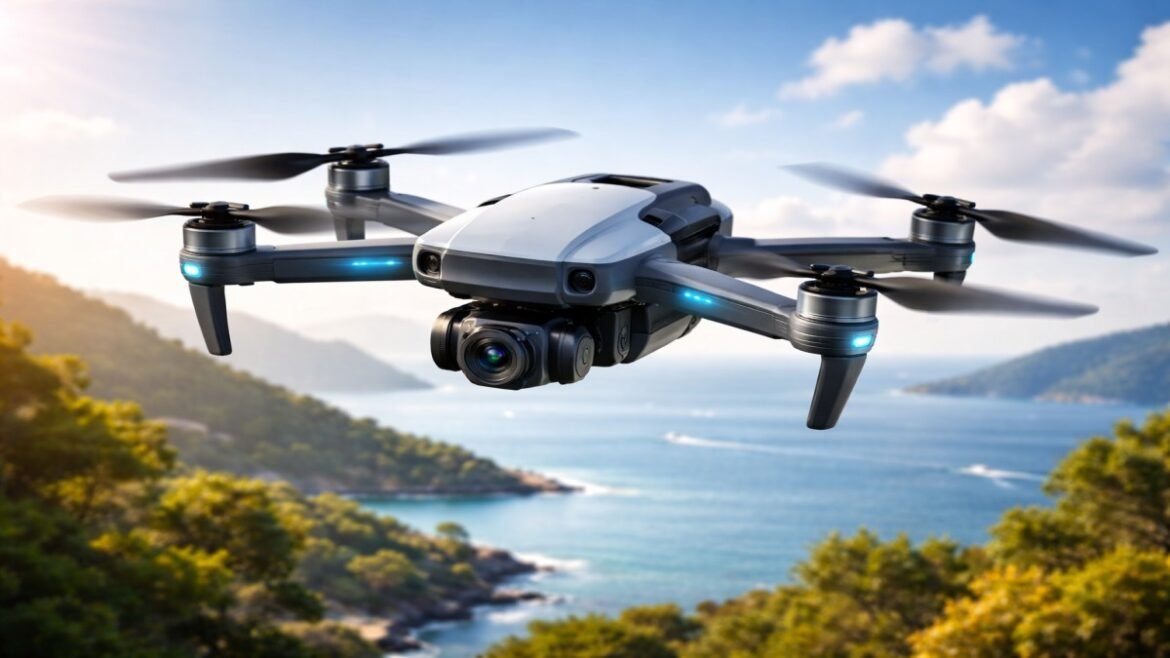
A UAV drone stands for Unmanned Aerial Vehicle. Simply put, it’s an aircraft that flies without a human pilot on board. Instead of sitting inside the cockpit, the operator controls the drone remotely or lets it fly autonomously using programmed flight paths and GPS.
Think of it as a flying robot with eyes in the sky. Whether it’s capturing breathtaking aerial photos or surveying farmland, a UAV drone acts as your remote-controlled assistant in the air.
History of UAV Drones
Early Military Development
UAV drones didn’t start as recreational gadgets. Their roots trace back to military experiments in the early 20th century. During World War I and II, basic unmanned aircraft were tested for surveillance and target practice.
Fast forward a few decades, and UAVs became essential in military intelligence and reconnaissance. They reduced the risk to human pilots while offering real-time aerial data.
Commercial and Civilian Expansion
Over the last 15 years, drone technology has exploded into civilian life. Companies like DJI revolutionized consumer drones, making them affordable and easy to use. Today, UAV drones are used in photography, agriculture, construction, logistics, and even filmmaking.
What once required a helicopter and a huge budget can now be done with a compact drone and a smartphone.
Types of UAV Drones
Not all UAV drones are created equal. Different tasks require different designs.
Fixed-Wing Drones
These look like small airplanes. They’re efficient for long-distance flights and large-scale mapping. Because they glide instead of hover, they use less energy and can stay in the air longer.
Best for: Surveying, agriculture, military reconnaissance.
Multi-Rotor Drones
This is the most common type. Quadcopters (four rotors) fall into this category. They’re easy to control, can hover in place, and are perfect for photography.
Best for: Aerial photography, videography, inspections.
Single-Rotor Helicopter Drones
These resemble traditional helicopters. They’re more efficient than multi-rotor drones but more complex to operate.
Best for: Heavy lifting and industrial applications.
Hybrid VTOL Drones
VTOL stands for Vertical Take-Off and Landing. These combine fixed-wing efficiency with hovering capability.
Best for: Long-range missions requiring precise landing.
Key Components of a UAV Drone
Ever wondered what makes a drone fly? Let’s break it down.
Frame and Structure
The frame holds everything together. It’s usually made from lightweight materials like carbon fiber or aluminum to ensure durability without adding extra weight.
Propulsion System
This includes motors, propellers, and electronic speed controllers (ESCs). They generate lift and control movement.
Flight Controller
Think of this as the brain of the drone. It processes data from sensors and adjusts the motors to stabilize flight.
Sensors and Cameras
Modern UAV drones are packed with technology:
- GPS modules
- Gyroscopes
- Accelerometers
- Obstacle avoidance sensors
- High-resolution cameras
These allow precise navigation and stunning 4K video capture.
How UAV Drones Work
A UAV drone works through a combination of hardware and software. When you move the joystick on your remote, signals are transmitted wirelessly to the drone. The flight controller interprets those commands and adjusts motor speeds accordingly.
If it’s flying autonomously, GPS coordinates guide the drone along a pre-set route. Sensors continuously monitor altitude, speed, and orientation to keep it stable.
It’s like having a tiny pilot inside, making thousands of micro-adjustments every second.
Applications of UAV Drones
The versatility of UAV drones is mind-blowing.
Military and Defense
UAV drones provide surveillance, intelligence gathering, and sometimes combat support. They reduce risks and increase operational efficiency.
Agriculture
Farmers use drones to monitor crops, assess irrigation, and even spray pesticides. This boosts efficiency and reduces waste.
Real Estate and Photography
Aerial views sell properties faster. Drone photography provides cinematic perspectives that were once impossible without expensive equipment.
Surveying and Mapping
Construction companies use UAV drones to map land and monitor project progress. It saves time and improves accuracy.
Conclusion
UAV drones have transformed from military tools into everyday technology. They’re reshaping industries, boosting efficiency, and unlocking new creative possibilities. Whether you’re a hobbyist capturing sunsets or a professional surveying land, UAV drones offer unmatched versatility.
The sky isn’t the limit anymore—it’s just the beginning.
FAQs
1. What does UAV stand for?
UAV stands for Unmanned Aerial Vehicle, meaning an aircraft operated without a human pilot onboard.
2. How long can a UAV drone fly?
Most consumer drones fly between 20 to 40 minutes per battery charge.
3. Are UAV drones legal to use?
Yes, but regulations vary by country. Registration and compliance with aviation rules are often required.
4. What is the difference between a drone and a UAV?
A drone is a common term for UAV. Technically, all drones are UAVs, but UAV is the formal term.
5. Can UAV drones fly in bad weather?
Most consumer drones should not be flown in heavy rain or strong winds due to safety and performance issues.